


 0
0

Across acquisition, retention and monetization, leaders are finding return where value proves durable — and rethinking the metrics that define growth.
There’s still plenty of activity in mobile growth. What’s less clear is how much of it holds up over time.
Teams can still buy installs at scale. What’s less predictable is the value those users generate over time — and how much of that outcome is actually driven by paid spend.
That tension is changing how growth leaders evaluate return.
We asked three senior leaders where they’re seeing the clearest ROI today — and which metrics they still rely on when performance is less straightforward to measure.
Their answers don’t point to a single channel or tactic.
They point to how the system works together.
ROI No Longer Lives in One Function
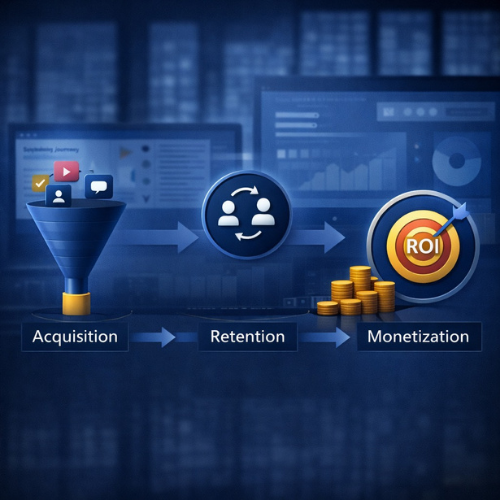
For years, acquisition, retention and monetization operated as separate tracks. Optimize one lever. Scale the result.
Under tighter conditions, that separation weakens performance.
Yaron Tomchin, CEO and CoFounder of Mobupps sees the strongest return when lifecycle stages reinforce one another:
“The clearest ROI comes from the acquisition and retention, not from either one. Many companies optimized acquisition heavily over the past years, but weak early retention decreased that investment. Now we see that improving the first user experience often delivers stronger returns than increasing acquisition spend. In practical terms, this means aligning marketing signals with product reality. If the acquisition brings users with the wrong expectations, monetization suffers later.
But besides that, product-led growth is gaining importance. It reduces dependency on paid media over time. Features like referral loops, personalization, and smarter onboarding increase lifetime value, which in turn allows acquisition teams to scale profitably again.
To my mind, ROI can also be measured per user lifecycle. Acquisition creates opportunity, retention creates value, and monetization captures it. When these functions operate separately, efficiency drops. When they operate together, growth becomes sustainable even under tighter market conditions.”
Acquisition creates opportunity. Retention determines whether that opportunity produces revenue.
Monetization Is a Strategic Lever
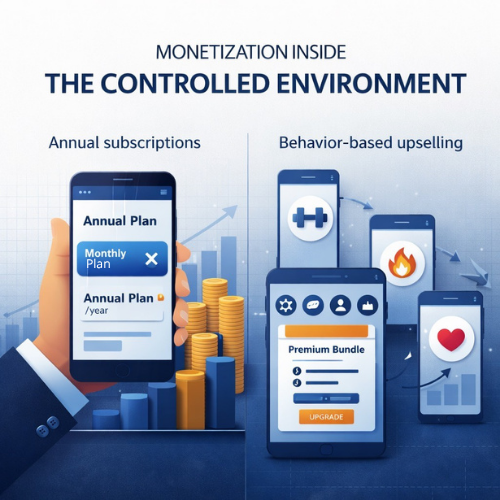
Ella Berylo points to monetization structure as a source of stability.
“The strongest ROI today comes from annual plan optimization and behavior-based upsell sequencing.
Annual subscriptions change the economics of growth immediately. When a user commits to an annual plan, payback periods compress and revenue predictability improves. This directly increases how much risk a company can responsibly take in acquisition. A higher annual take rate does not just lift revenue per user; it stabilizes cash flow and reduces exposure to early churn. Even a modest shift in plan mix toward annual subscriptions can materially improve cohort durability and margin expansion. Subscription benchmarks consistently show that longer commitment periods correlate with stronger lifetime value retention curves, which compounds over time.
Behavior-based upsell sequencing is the second high-leverage lever. Upsells convert when they are introduced at moments of demonstrated engagement rather than presented generically. If a user has already interacted deeply with a specific feature or category, that signal carries commercial meaning. Introducing a premium expansion, add-on, or bundle at that point aligns offer timing with behavioral readiness. This increases average revenue per user without increasing acquisition spend. The lift does not come from persuasion alone; it comes from relevance.
These two levers share one characteristic: they operate inside your controlled environment. Platform volatility affects acquisition efficiency. Annual conversion structure and contextual upsell timing remain internal decisions. In a market defined by auction pressure and attribution noise, internal monetization architecture offers the most stable and compounding return.”
Paid channels fluctuate. Pricing models and in-product sequencing remain internal decisions.
In volatile markets, internal systems offer predictability.
Retention Multiplies Return
Nana Erika Landau, Head of In-App Partnerships of Europe and Americas, Yango Ads describes ROI as a compounding effect.
“Retention and monetization improvements are where I’m seeing the fastest payback right now. The logic is straightforward. When you improve retention or monetization, you’re increasing the value of every user you’ve already paid for, plus every user you’ll acquire in the future. It’s a multiplier effect as buying more traffic without fixing those fundamentals is just pouring water into a leaky bucket.
The teams I work with stress-test retention and LTV assumptions first, then scale acquisition once the unit economics actually hold up. Where acquisition does have strong ROI potential is in channel diversification. 88% of consumer app ad spend is still concentrated in Google and Meta. That’s a massive amount of competition in two places. Advertisers who spread their mix across additional channels like DSPs, CTV, alternative networks, are seeing meaningful ROAS improvements, sometimes 2x or better at Day 30.”
Retention reduces waste. Diversification lowers auction pressure. Both influence margin.
The Metrics Gaining Authority

Measurement is adjusting alongside strategy.
Ella Berylo moves beyond surface efficiency:
“Cohort-based short-term ROI connected to projected lifetime value deserves increased trust. It links early revenue to long-term viability and reduces reliance on incomplete attribution.
Standalone CPI or install metrics provide limited visibility into revenue durability. Cost efficiency without monetization quality misleads decision-making.”
Nana Erika Landau makes a similar distinction:
“Incrementality-based LTV has become the metric I trust most, basically “did this spend cause real lift, and what’s the payback by cohort?” CPI and last-touch narratives have moved to the “useful signal but dangerous strategy” category.”
Cost remains relevant. Durability determines sustainability.
The Shift
Mobile growth strategy is becoming more constrained by economics.
What stands out across these perspectives is not a single winning channel or tactic, but a pattern:
Return improves when acquisition aligns with product experience, when retention reduces early drop-off, and when monetization is built into how value is delivered.
At the same time, measurement is moving toward metrics that reflect contribution over time, not just cost at the point of install.
None of this replaces scale.
But it changes what makes scale sustainable.


