


 0
0
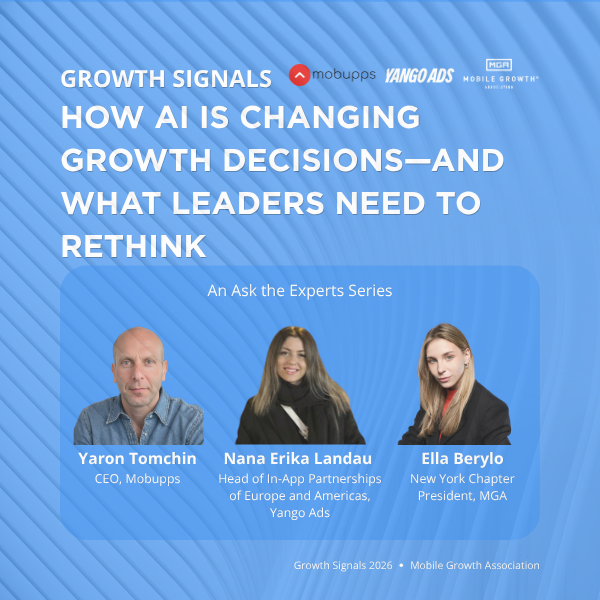
AI is changing how growth decisions are made, but not in the way most teams expected.
It hasn’t simplified decision-making.
It has compressed it.
What used to unfold over weeks—performance signals, budget adjustments, creative fatigue—now happens continuously. Teams are reacting in near real time, often before they have full confidence in what they’re seeing.
That shift creates a new kind of pressure.
Not on execution, but on judgment.
Growth leaders are no longer limited by how quickly they can optimize. They are limited by how clearly they can define what “good” looks like before the system starts moving.

Speed Without Friction Changes Risk
Yaron Tomchin, CEO of Mobupps, describes how AI has already reshaped the pace of decision-making:
“AI has already changed decision-making by reducing reaction time. Previously, teams analyzed performance weekly or even monthly. Today, optimization cycles happen daily or in real time. This changes execution speed and influences strategic decision-making.
AI is extremely effective at identifying patterns humans would miss, such as creative fatigue signals, audience saturation, or early performance shifts across channels. This allows teams to reallocate budgets faster and avoid prolonged inefficiencies. If the strategy objective is wrong, AI simply reaches the wrong outcome faster.
The biggest practical change is that AI frees teams from manual optimization and shifts their focus toward hypothesis building and interpretation. Leaders now spend more time asking whether the growth is incremental, scalable, and aligned with long-term value.
In my experience, AI works best when combined with clear business constraints. It helps answer how to scale, but leadership still needs to define what growth should look like.”
From a CMO perspective, this changes the risk profile of growth.
AI does not just improve efficiency. It increases the speed at which capital is deployed—and potentially misallocated.
A targeting mistake or flawed objective is no longer a slow leak. It can scale across channels in days. That makes constraint-setting—defining acceptable CAC, payback windows, and LTV assumptions—more important than optimization itself.
The challenge is not speed.
It is control.
Faster Insight Doesn’t Mean Better Decisions
Ella Berylo, New York Chapter President of the Mobile Growth Association, points to a structural issue many teams underestimate:
“AI accelerates insight generation. It clusters users faster, detects churn patterns earlier, generates creative variants at scale, and forecasts revenue trajectories with higher speed. However, acceleration does not automatically create coherence. Many organizations still operate with disconnected attribution dashboards, subscription platforms, and BI tools. The central challenge remains data integration.
AI is most effective when connected to a centralized analytics layer that reflects marketing spend, subscription revenue, cohort behavior, and financial performance in one place. Without unified architecture, teams risk making fast decisions based on partial visibility.
The advantage now lies in pairing AI speed with data integrity.”
At a large app publisher, this shows up in very practical ways.
Marketing, product, and finance rarely operate on the same definitions of performance. Revenue recognition lags acquisition data. Cohort behavior evolves after campaigns have already scaled. AI does not reconcile these differences—it acts on them.
Teams move faster, but often with less shared context.
Marketing sees performance improving.
Finance sees margins tightening.
Product sees retention unchanged.
Without a unified view, organizations are not constrained by lack of data.
They are constrained by lack of alignment.
And in that environment, speed amplifies fragmentation rather than clarity.

What a Growth Leader Should Do Now
Nana Erika Landau, Head of In-App Partnerships (Europe and Americas) at Yango Ads, approaches the shift from a different angle: what a growth leader should actually do when resetting strategy under these conditions. She recommends:
“Stop treating paid UA as the entire strategy. When acquisition costs are volatile, throwing a budget at a leaky funnel just buys a bigger problem. Vanity metrics make great slides but lousy decisions.
Start with retention triage and monetization fundamentals. If D1/D7 retention is soft, the priority is fixing onboarding, early progression pacing, and economy balance, before scaling anything. Measurement-wise, start running incrementality tests. Even simple geo holdouts can reveal what’s actually driving net-new growth versus what’s just taking credit for it.
Double down on two areas:
Live ops discipline. Not random events, but a real calendar with segmented offers that match player intent. The teams doing this well treat it like a product function.
Diversified growth mix. Cross-promo, referrals, CRM reactivation, and channel expansion beyond the default walled gardens. The biggest “easy wins” in acquisition right now are coming from incrementality gains and smarter channel allocation.”
Framed in the context of AI, this is less about tactics and more about sequencing.
AI makes it easier to scale acquisition.
It does not make it safer.
If retention and monetization are weak, AI will simply accelerate the rate at which inefficient users are acquired. That increases spend without improving underlying economics.
This is where many growth leaders get it wrong.
They assume better optimization will fix performance.
In practice, it often amplifies existing weaknesses.
For a CMO resetting strategy, the implication is clear:
• Stabilize retention before increasing spend
• Validate incrementality before trusting reported performance
• Build monetization depth before scaling acquisition
• Diversify channels before dependency becomes risk
This is not a tactical shift.
It is a capital allocation decision.
The Emerging Decision Model
Taken together, these perspectives point to a broader shift in how growth decisions are made.
Three changes stand out:
Decisions compress
Teams have less time to interpret signals before acting.
Errors scale faster
Mistakes compound more quickly under automated systems.
Fundamentals matter earlier
Retention and monetization issues surface sooner in the lifecycle.
This changes the role of leadership.
Growth is no longer about optimizing campaigns faster.
It is about defining the conditions under which optimization produces the right outcomes.
The Shift
AI has not made growth easier to manage.
It has made it harder to justify.
Decisions happen faster, but with less certainty. Performance can improve quickly, but so can inefficiency. Attribution signals exist, but they are less reliable in isolation.
The advantage no longer comes from optimizing faster.
It comes from knowing where not to trust the system—and where to intervene.
For growth leaders, that means shifting focus:
From execution to constraint-setting
From attribution to validation
From scale to sustainability
AI does not remove the need for judgment.
It makes the consequences of it show up faster.
Series Articles
Growth Signals: The Industry Shift
Growth Signals: The End of Volume-Driven Growth
What Pricing Model Should You Choose in 2026?
Where Mobile Growth Leaders Are Seeing ROI Now
Rethinking Mobile Growth Under Privacy and Platform Constraints


